Written by Generation Archives. Practical writing advice for family archives. We make a private tree where notes and bios sit on each person; you can use the same habits in any notebook or program.
How to write family stories that belong on a tree
A family tree full of dates is a skeleton. Stories are the reason relatives open it. This guide shows how to write short pieces that stay attached to the right person, stay readable twenty years from now, and do not publish someone else’s private life by accident.
One person, one home for the story
Put the story on the person it is mainly about. If the story is about a marriage, put a short version on each spouse and a longer version on one of them, with a pointer on the other: “See Patricia’s notes for the 1972 wedding story.”
Avoid a single giant document titled “Family history.” Those files are hard to search and easy to lose. Person-linked notes survive moves between programs better when each note names its subject in the first sentence.
A simple shape that works
Most useful family stories fit this outline:
- Who and when. One sentence.
- What happened. Three to eight sentences.
- Why it matters to the family. One or two sentences.
- How you know. Source line.
Example: “Helen Smith taught second grade in Cedar Rapids from about 1952 to 1978. She kept a box of class photos labeled by year. The box is how we identified several cousins in the 1960 picnic picture. Source: conversation with Patricia Smith, November 2026.”
That is enough. You are not writing a novel.
Facts, voice, and gossip
- Facts belong in dated fields when you have them: birth, marriage, death, places.
- Voice belongs in notes: humor, catchphrases, how someone told a story.
- Gossip about living people usually does not belong on a shared tree. If a relative asked you not to write something down, honor that. See what to record about living people.
When a story includes a conflict, prefer neutral wording and name your source. “June said the farm was sold in 1955; Robert remembered 1957” is better than picking a winner in prose.
Length limits that help
Aim for 150–400 words per story block. Longer memoirs can live as linked documents or PDFs, with a summary on the person. Short blocks get read. Long walls of text get skipped at reunions.
If you have an interview transcript, do not paste the whole thing onto the profile. Extract the story, then cite the interview. How to interview relatives covers capture; this page covers what you publish on the tree afterward.
Pair stories with pictures
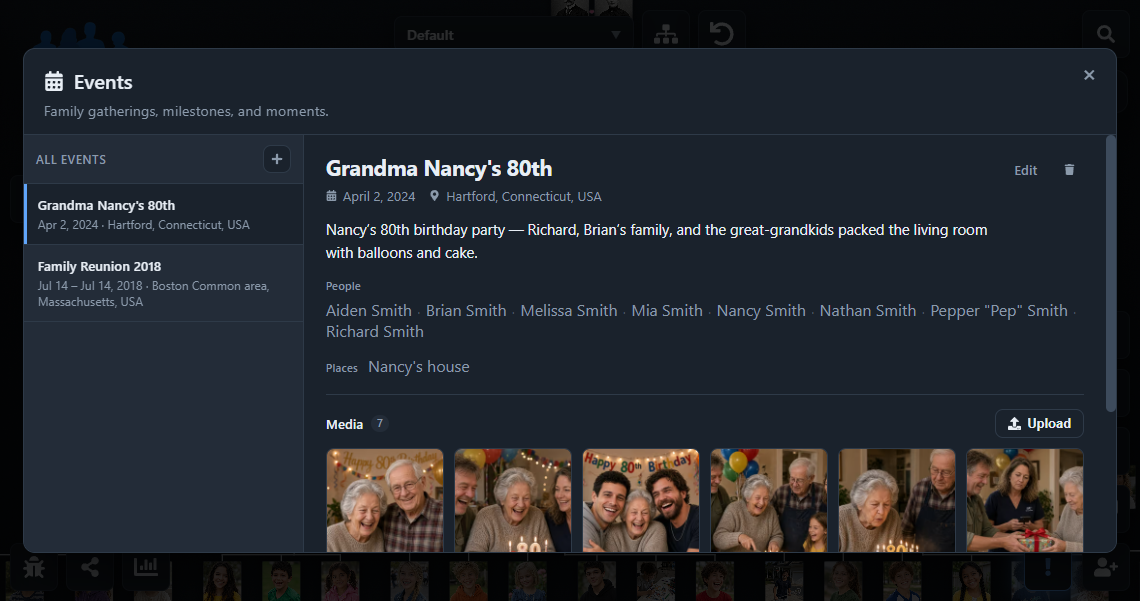
A story about a reunion is stronger next to the tagged photo. A story about a trade is stronger next to a tool photo. Tag faces first, then write. Organize family photos for a tree is the workflow; the story is the caption that outlives the person who remembered it.
Privacy before you invite
Before collaborators can open the tree, skim stories for:
- Exact addresses of living people
- Medical details nobody asked to share
- Conflict that names a living person who has not agreed
Trees in Generation Archives are private by default, but invitees can still copy what they see. Share a family tree safely has a checklist.
Frequently asked questions
Should I correct spelling in Grandma’s letters when I quote them?
Quote important lines as written, then add a plain-language note if a name is unclear. Do not silently “fix” a historical spelling that might be a clue.
Where do I put recipes, jokes, and songs?
On the person who is remembered for them, or on a family notes page if your tool has one. Keep the item short and name the source.
What if two stories contradict each other?
Keep both with sources. Contradiction is information. A later record may settle it.
Can I use AI to polish a story?
You can use tools to clean grammar, but do not invent details. Anything you cannot cite should stay out.
How do I start if I hate writing?
Write five factual sentences after each interview. Expand later. A thin true note beats a polished guess.
Try the demo Sample tree Create a free account
Related
- How to interview relatives for family history (with questions that work)
- What to record about a living person, and what to leave off a shared tree
- How to cite a family photo, letter, or interview
- How to organize family photos for a family tree
- How to share a family tree safely with relatives
- A private family tree you share only with relatives
- How to start a family tree: a beginner checklist
- /articles/