Written by Generation Archives. This is practical photo-dating advice for family archives, not a museum conservation course. We make a tree app that tags people in photos; the dating method works with any folder or album.
How to date old family photos without inventing a year
An undated photograph is still useful. An invented date written in ink is harder to undo than a blank. This guide shows how to narrow a year range with clues you can point to, how to write that range so the next person trusts it, and how to attach the result to people in a family tree.
Start with what the object already says
Before you guess from clothing, read the photograph itself.
- Writing on the back or album page. Names, places, and “Xmas 1963” are evidence. Copy the wording exactly into a note.
- Studio marks. A photographer’s stamp can place a town and sometimes a decade.
- Print process. Instant prints, postcard backs, and certain border styles suggest eras. You do not need to be an expert; note what you see (“white border, deckled edge”) so someone else can refine it later.
- File metadata for digital copies. Creation dates on phone exports are often wrong for scanned prints, but they can date when a relative emailed the scan.
Write those facts first. Dating starts as citation work, not fashion history.
Narrow the range with shared context
Ask questions that produce a range instead of a single year.
- Who is present, and how old do they look? If a known child is a toddler in one photo and in school in another, you already have bounds.
- Who is missing? A spouse who died in 1978 cannot appear in a later outdoor picnic unless the identification is wrong.
- Where was this taken? A house the family left in 1955, or a car model introduced in 1967, tightens the window.
- What event is it? Weddings, graduations, military uniforms, and holiday decorations often come with a season even when the year is fuzzy.
Keep competing theories. “About 1958–1962, based on Aunt June’s age and the Chevy” is better than “1959” with no reason.
Clothing and technology are clues, not verdicts
Clothing, hairstyles, and gadgets help when you already have a decade candidate. They mislead when you treat them as proof. Rural and urban styles differ. Immigrants keep older clothes. Studio portraits can look formal long after everyday fashion moved on.
Use them as supporting notes: “Women’s hems and the TV set match late 1960s more than early 1950s.” Then stop. Do not force a single year from a hemline.
How to write the date on the photo and in the tree
Use a consistent pattern so software and relatives can read it the same way.
- Known day:
15 June 1964 - Known year:
1964 - Range:
about 1962–1965 - Season only:
Christmas, about 1971 - Unknown: leave blank, and put “date unknown as of 2026-11-18” in the note
In the citation, say who decided the range and why. Example: “Date estimated 1962–1965 by comparing Helen’s age to the 1960 school photo; clothing consistent with early 1960s. Note by Generation Archives user, November 2026.” See how to cite a photo, letter, or interview.
Attach the photo to people, not only to a folder
A dated file in a folder named “misc” still fails the next generation. Tag every identified face, put the date on the media record, and repeat the source note on the people who appear. For a full workflow from shoebox to tree, use organize family photos for a tree.
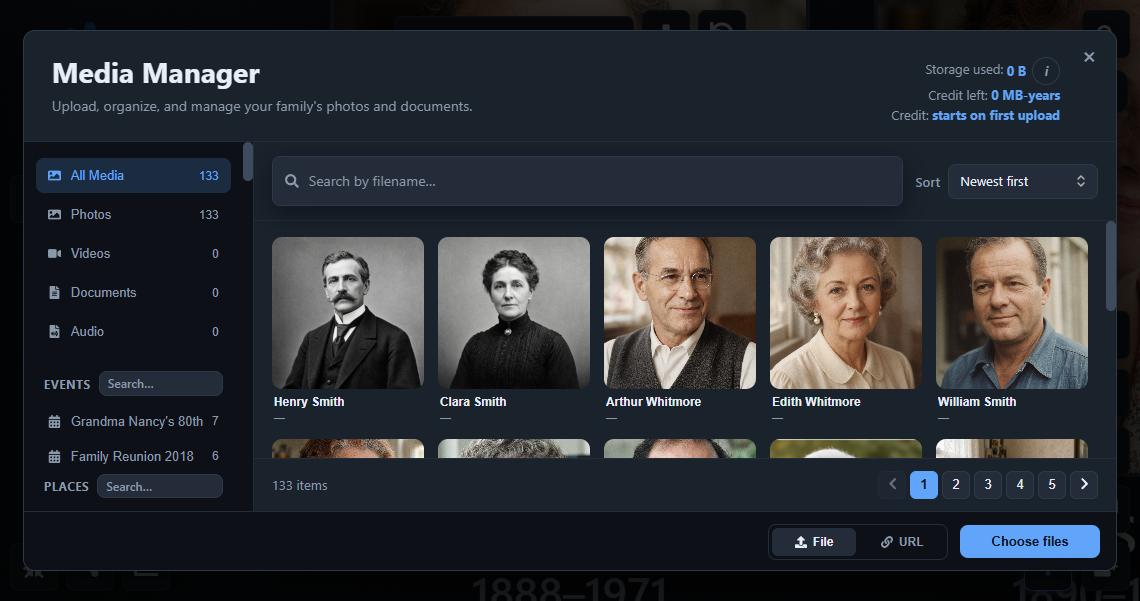
If you want to see how tagged media looks next to people before you import your own, open the sample tree or read tour the sample Smith family tree.
Frequently asked questions
What if two relatives insist on different years?
Record both claims with names and dates of the conversations. Prefer a range that covers both until a caption, school record, or newspaper settles it.
Should I write the date on the physical print?
Pencil on the reverse edge is safer than ink on the face of the print. Never press hard. For valuable originals, keep the date in a separate inventory sheet and on the digital copy.
Can software auto-date scans?
Face-recognition and “memories” features sometimes guess. Treat those guesses as prompts to investigate, not as finished citations.
What if I only know it is “before Grandpa died”?
Write before 1987 (or whatever the death year is) and cite who supplied that limit. A one-sided bound is still better than a fake exact year.
Does a tree app replace a photo inventory?
No. Keep originals backed up. The tree is the index that ties faces to people. The inventory is how you find the file again.
Try the demo Sample tree Create a free account
Related
- How to organize family photos for a family tree
- How to cite a family photo, letter, or interview
- How to interview relatives for family history (with questions that work)
- How to start a family tree: a beginner checklist
- Tour the sample Smith family tree
- Free printable family group sheet (PDF)
- A private family tree you share only with relatives
- /articles/